
Introduction
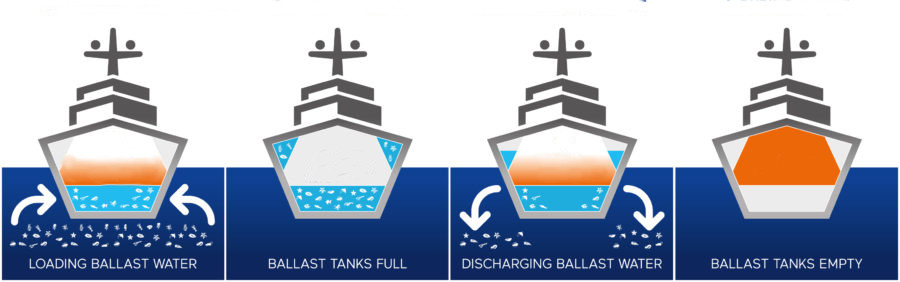
Every ship, whether it is a bulk carrier, tanker, or container vessel, relies on ballast water to maintain stability, trim, and structural strength during voyages. Ballast tanks are filled with seawater when cargo is unloaded and emptied when cargo is loaded, ensuring the ship remains safe and balanced.
However, this simple process carries a major environmental risk. When ballast water is taken in at one port, it brings along thousands of microorganisms, larvae, plankton, and even small fish. When the same water is discharged in another region, these organisms can invade foreign ecosystems and create ecological imbalances. This issue is so severe that invasive species transferred by ships’ ballast water are considered one of the greatest threats to marine biodiversity today.
The Global Concern
• Zebra Mussels in North America, carried from the Black Sea via ballast water, caused billions of dollars in damage by clogging pipelines and disrupting ecosystems.
• Asian Kelp has spread to Australian waters through ballast water, threatening local fisheries.
• Many more examples exist worldwide, underlining the global scale of the problem.
Recognizing this threat, the International Maritime Organization (IMO) adopted the Ballast Water Management (BWM) Convention in 2004, which entered into force in 2017. The convention makes it mandatory for all ships to manage their ballast water in an environmentally responsible way.
Why Ballast Water Management is Essential
1. Environmental Protection – Prevents the introduction of non-native species.
2. Compliance – Ships must follow international rules to avoid detention and fines.
3. Operational Safety – Sediments in ballast tanks can affect pumping systems and reduce tank capacity.
4. Reputation – Shipping companies are increasingly judged on their environmental practices.
Methods of Ballast Water Management
1. Ballast Water Exchange (BWE)
• Ships traditionally exchanged ballast water mid-ocean, at least 200 nautical miles from shore and in waters deeper than 200 meters.
• The idea is that oceanic water has fewer organisms capable of surviving in coastal areas.
• Although effective to some degree, BWE is risky in rough weather and is being gradually replaced by treatment systems.
2. Ballast Water Treatment Systems (BWTS)
Modern vessels are now equipped with BWTS, designed to meet IMO’s D-2 standard, which limits the concentration of organisms in discharged ballast water.
• Filtration – Mesh filters remove large organisms and sediments.
• UV irradiation – Ultraviolet light neutralizes bacteria and plankton.
• Chemical treatment – Chlorination, ozonation, or other biocides kill microorganisms.
• Deoxygenation – Removes oxygen from ballast tanks, suffocating aquatic life.
3. Operational and Record-Keeping Requirements
• Ships must maintain a Ballast Water Management Plan approved by the flag state.
• A Ballast Water Record Book is mandatory, recording each operation (uptake, treatment, discharge).
• Port State Control (PSC) can inspect and verify compliance.
Challenges Onboard
• Power Demand: BWTS consume significant electrical power.
• Crew Training: Engineers must understand system operation and maintenance.
• Sediment Management: Sludge buildup in tanks complicates cleaning.
• Cost: Retrofitting BWTS is expensive, especially for older ships.
Conclusion
Ballast water management is not just a technical requirement — it is an environmental duty. As seafarers, we are custodians of the sea. By ensuring compliance with BWM practices, we protect marine life, preserve ecosystems, and contribute to sustainable shipping. The future of shipping lies not only in carrying goods but also in carrying them responsibly.